HIV/AIDS

The following piece was originally written by Australian HIV/AIDS activist Nic Holas and founder of the advocacy organization, The Institute of Many. It appeared first here in Sydney gay news magazine, SX. As is reported at ABC News, new HIV infection rates remain at 20 year highs, and sexual stigma runs rampant, especially among men who have sex with men.

==

Sebastian Robinson was in a production about Australia’s early response to HIV when he was diagnosed HIV positive. But rather than retreat from the play, he drew strength from the very stories he was conveying on stage.

I first met Sebastian Robinson in February of this year, in Sydney, during the Mardi Gras season. I was perusing the apps in my habitual manner when a message popped up. We got to chatting and realised we had some things in common. He was in town performing in a verbatim play, The Death of Kings, about Australia’s early response to HIV. I was an HIV positive activist and knew some of the people in the play. We were both being interviewed for a documentary, Transmission, which chronicled Australia’s response to HIV.

Read Full Article

The Stigma Project is an organization founded in 2012 by Chris Richey and Scott McPherson. Their mission is “to lower the HIV infection rate and neutralize the stigma associated with HIV/AIDS.” We wanted to highlight one of their great visual campaigns called “Live HIV Neutral,” which tackles some common sources of stigma surrounding HIV discussions, including the “clean” vs. “unclean” dichotomy that plagues those using dating apps and the misinformation that continues to spread about how HIV is transmitted.

Read Full Article

This essay was originally finished in December 2013 for MFA in Creative Writing program at Goddard College. I’ve returned to a year later because I think the questions explored: those of haunting and the desire to connect to the past of HIV/AIDS while trying to move forward resonate today. It is a long read, and uses some conventional academic language and citation, but it’s also unique in its creative and liberatory impulse throughout. Enjoy.

==

“Sometimes people try to destroy you, precisely because they recognize your power — not because they don’t see it, but because they see it and they don’t want it to exist.” – bell hooks

I have been told many times, even if indirectly, that I do not deserve to exist. The exploration begins here because, in the question of my presence, I recognize my own words as simultaneously representing today’s grief and the future of my body, as words, to survive in a haunting against these attempts to destroy me. As I look at Kristin Prevallet’s I, Afterlife and Hervé Guibert’s Ghost Image, I do not intend to show that these works necessarily detail grief and haunting in the same way I see my own experiences. However, what I will show is that through narratives of grief, their bodies (or those of others) loom over me, as the reader. Through literature, particularly that which fuses together various forms, the traces of these narratives become embedded in my own. To this extent, in Prevallet and Guibert’s works I can use the ways they bring ghosts back to life to better understand the ghosts that haunt me personally, working beyond grief and anger to find pleasure in this reanimation. At the same time, I will ask exactly what can be reclaimed, and what it means to structure my own narrative writing with an understanding of incompleteness.

Read Full Article

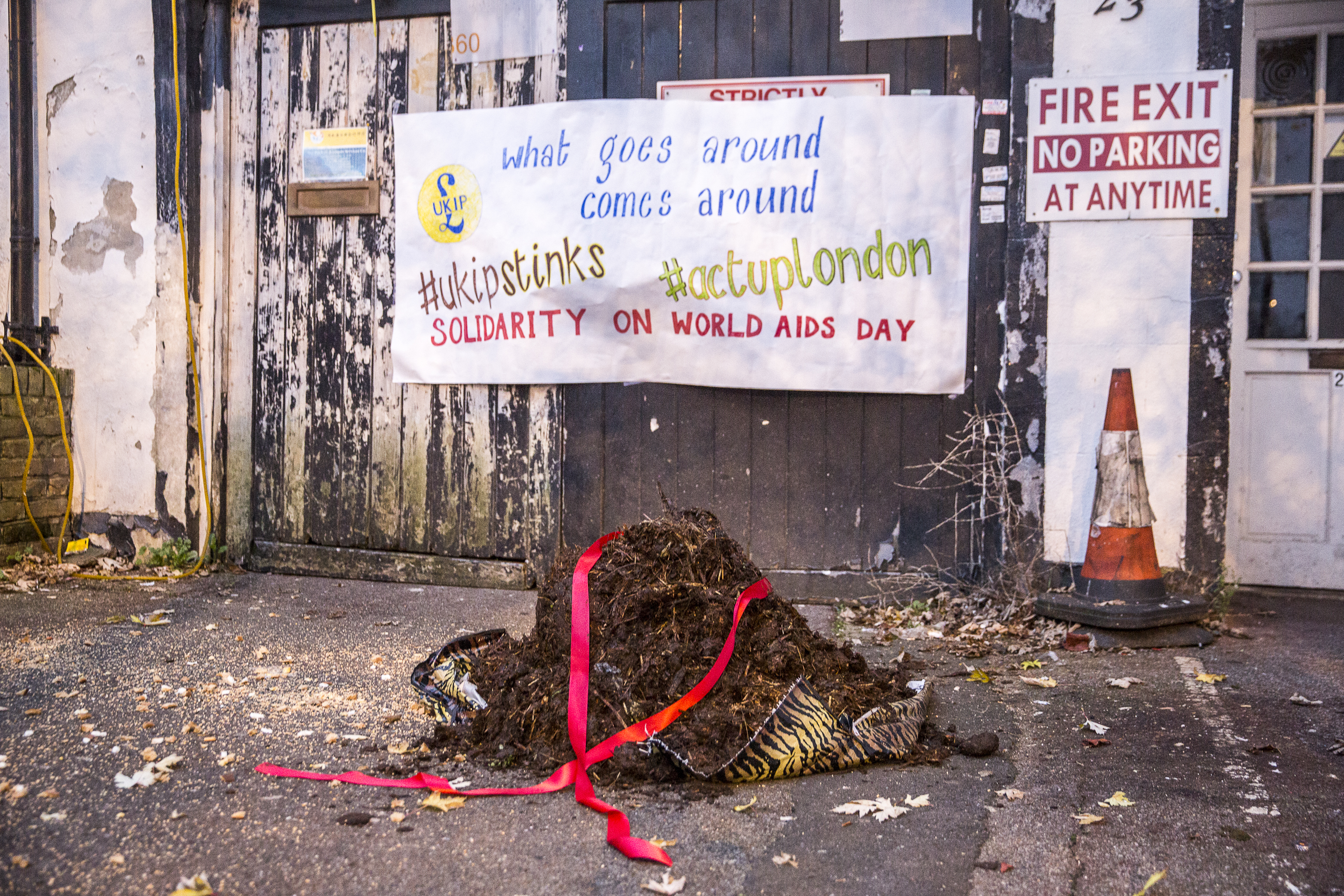
In an action on World AIDS Day December 1st, ACT UP London fought back against comments by a prominent UK political party leader whose remarks against people living with HIV/AIDS highlighted just how much stigma is fueling the epidemic. This was their “gift” to UKIP, which was coordinated with a #ukipstinks campaign.

actup-wad-2014-6570

Read Full Article

Change, as we all well know, is not easy and it is not cheap. Our Viral Lives may have just started as an idea, but we’re ready to rapidly expand by the middle of 2015, if we can secure two important things: 1) fiscal sponsorship & 2) outside grant or sponsorship money. The first allows us to be affiliated with a 501(c)(3) organization, making us eligible for a lot more grants & for individual donors to create donations that could be written off on their taxes. The second would allow us to expand considerably. This budget and potential sponsorship avenues are highlighted at Our Viral Lives Budget Plan.

Read Full Article

In recent years, this has been an alarming rise in new HIV infections among youth ages 18-30. One group of 28 individuals came together to address the challenges in HIV prevention, treatment, research, and broader cultural stigma. This is their video. What do think of their work? What are some other strategies you might recommend in dealing with HIV/AIDS in an under 30 crowd? Share your ideas in the comments section.

Today I went to get my quarterly HIV test to renew my Truvada (PrEP) prescription. It was the first time in my life I’ve ever had gotten an HIV test using another HIV prevention tool other than condoms. There’s always some thought in the back of my mind that I could get HIV because I know that not having sex with a condom will possibly give me HIV. This has been ingrained since I was a middle school student. But I did feel more at ease and, as a result, I started to think more about what’s worried me and just how much I’ve grown.

Read Full Article

I don’t think there is a whole lot more that I can say about Ferguson that hasn’t been articulated before. I do, however, think that the disregard for black lives extends to another arena: HIV prevention and treatment. A 2010 study from the CDC yielded shocking results. Among men who have sex with men (MSM), black men accounted for 39% of all new infections, and those ages 13-24 accounted for a particularly high percentage of the new cases. In 2011, the CDC launched a “Testing Makes Us Stronger” campaign that I interviewed a then-director about. Despite progress at the federal level, locally and statewide, there has been a disregard for more diversity in HIV/AIDS prevention, treatment, and education.

Read Full Article